The Foundations of Product
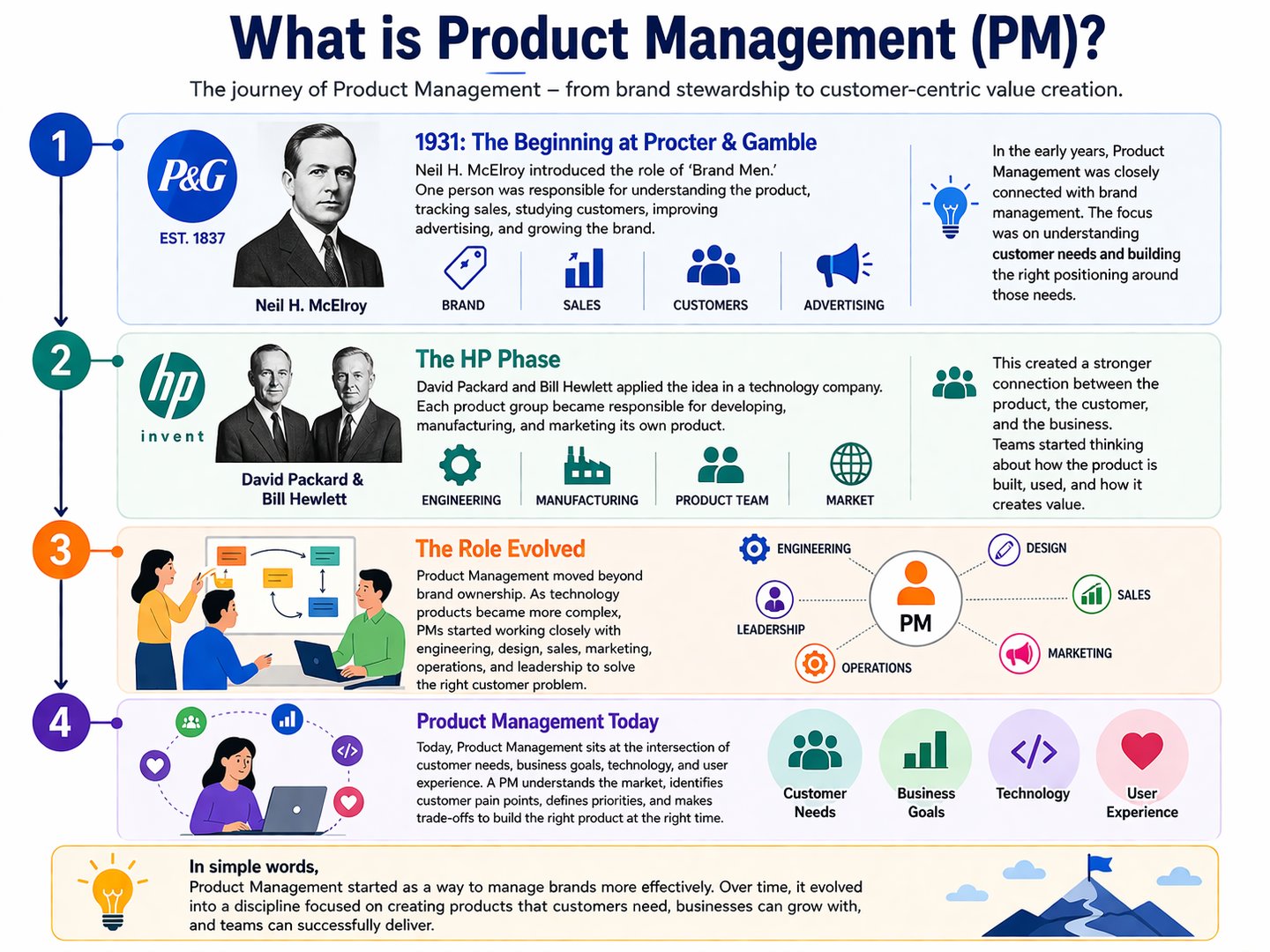
The modern idea of Product Management began in 1931 at Procter & Gamble, when Neil H. McElroy wrote a memo introducing the role of “Brand Men.” The idea was simple but powerful. One person should be responsible for understanding the product, tracking sales, studying customers, improving advertising, and finding ways to grow the brand. In the early years, Product Management was closely connected with brand management. The focus was not only on promoting the product, but also on understanding customer needs and building the right positioning around those needs.
The next major phase came from Hewlett-Packard. David Packard and Bill Hewlett took this idea further and applied it in a technology company. At HP, each product group was responsible for developing, manufacturing, and marketing its own product. This created a stronger connection between the product, the customer, and the business. Product teams were not just thinking about how to sell the product. They were also thinking about how the product was built, how customers used it, and how it could create business value.
Over time, Product Management moved beyond advertising and brand ownership. As technology products became more complex, the role of the product manager also evolved. A PM started working more closely with engineering, design, sales, marketing, operations, and leadership. The role became less about managing a product from the outside and more about connecting different teams to solve the right customer problem.
Today, Product Management sits at the intersection of customer needs, business goals, technology, and user experience. A product manager is responsible for understanding the market, identifying customer pain points, defining product priorities, and making trade-offs. The role is not just to build features, but to make sure the team is building the right product for the right customer at the right time.
In simple words, Product Management started as a way to manage brands more effectively. Over time, it evolved into a discipline focused on creating products that customers need, businesses can grow with, and teams can successfully deliver.
What is Product Management (PM)
The Product Lifecycle
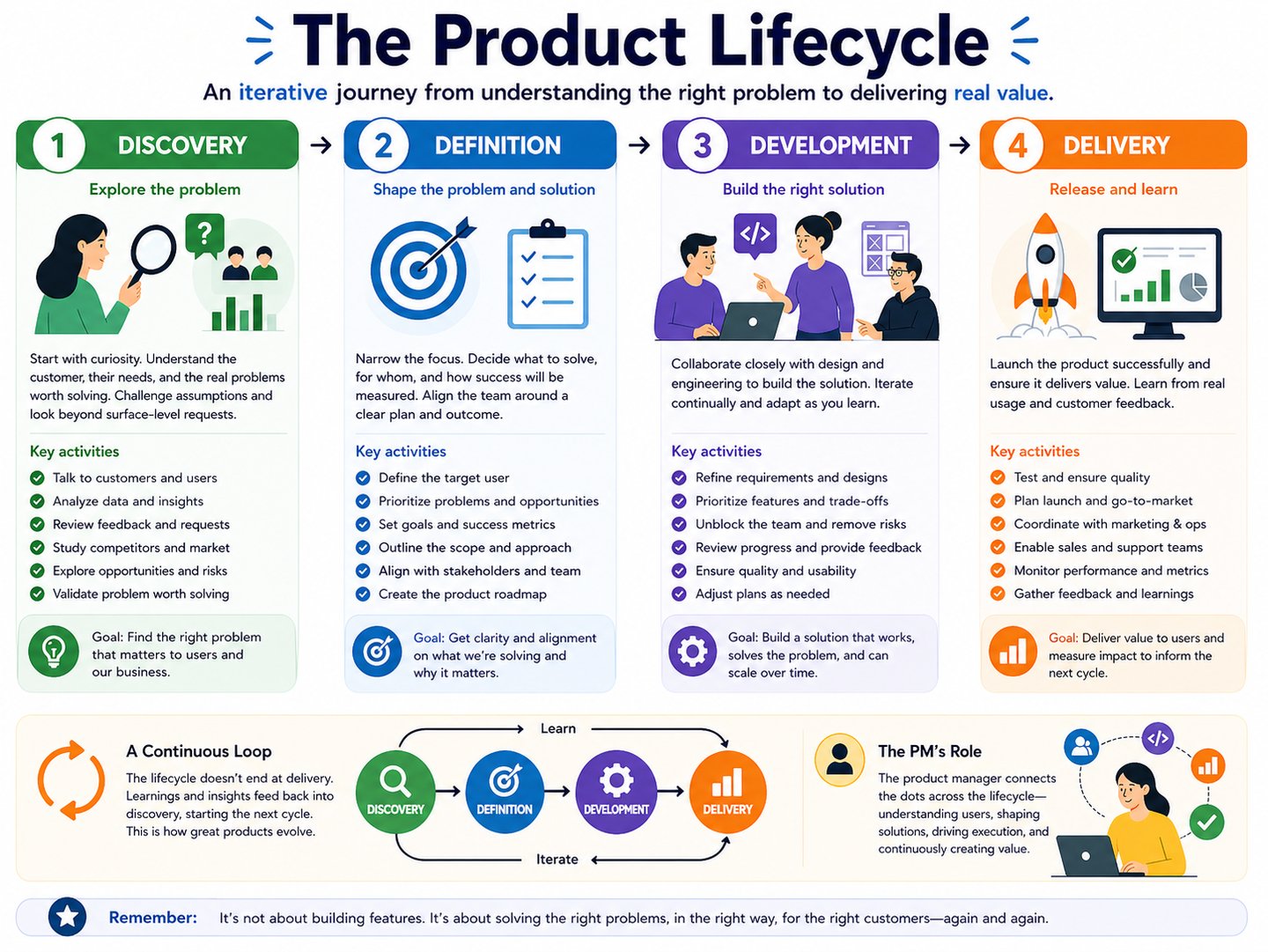
To understand how Product Management works day-to-day, it is useful to look at the product lifecycle. While it is often explained in stages, in reality it is not a straight sequence. These stages overlap, repeat, and evolve as the product grows.At a high level, the lifecycle can be broken into four parts: Discovery, Definition, Development, and Delivery.
Discovery
Discovery is where everything begins. At this stage, the focus is not on building, but on learning.
A product idea can come from many places. It could be customer feedback, internal suggestions, market shifts, or changes in business priorities. However, the first idea is rarely the right answer. The role of the product manager here is to dig deeper and understand what is actually happening.
This involves exploring customer behavior, identifying pain points, and questioning assumptions. The goal is to separate real problems from surface-level requests. Not every request is worth solving, and not every problem is large enough to matter.
Definition
Once there is clarity on the problem, the next step is to define it clearly for the team.
This stage is about focus. From a broad set of insights, the team needs to decide what to prioritize and what to leave out. The product manager helps shape this by identifying the target user, setting clear objectives, and defining how success will be measured.
Without this step, teams often move forward with different interpretations of the same problem. Definition ensures everyone is aligned before moving into execution.
Development
Development is where the team starts building the solution.
This is a collaborative phase involving product, engineering, and design working closely together. The product manager’s role here is to maintain direction, clarify requirements, and make trade-offs when constraints arise.
Plans will change during development. New information, technical limitations, or unexpected challenges can shift priorities. The PM ensures that despite these changes, the team remains focused on solving the core problem.
Delivery
Delivery is when the product reaches the user.
This stage includes testing, launching, and coordinating across teams such as marketing, operations, and support. A successful delivery is not just about releasing the product, but making sure it is usable, stable, and understood by users.
After launch, the product manager evaluates how the product performs. Feedback, usage data, and outcomes help determine what worked and what did not. These insights feed directly into the next round of improvements.
In simple terms, the product lifecycle is a continuous loop rather than a one-time process. Product managers move back and forth between these stages, constantly learning and adapting. The goal is not just to deliver features, but to keep improving the product in a way that creates real value over time.